Baby Shower Ancient Egypt Style Snippet from MAGIC OF THE NILE

I’m excerpting a scene from Magic of the Nile.  The Female Main Character, High Priestess Tyema, is being feted by her female relatives, close to the time of the birth. Paratiti is her aunt.

MagicOfTheNile_600x900Finally, as the temple servants brought plates of honeyed cakes and figs at the end of the meal, Paratiti gestured at the oversized basket, “Bring the gift now.”

Her daughters hauled the sturdy container to Tyema, setting it on the ground next to her. Smiling, she said, “I can’t imagine what this might be.” Lifting off the lid, she set it aside and removed the top layer of straw packing. Below the straw she found a fine pair of birthing bricks, smooth, freshly painted in white, with stunning portraits of the goddesses Hathor and Tawaret drawn on the sides in turquoise, gold and red. Protective spells were inked in black hieratic. Tyema sat with a brick in either hand, examining the art.

Tawaret Depositphotos

“I hope your god won’t mind, but birthing a child is a female mystery and he isn’t known for involvement with such things. His crocodiles come from eggs after all. We were afraid you wouldn’t have proper bricks here when the time comes.” Paratiti gestured at the temple behind the garden.

The story:

After a childhood spent scorned and ignored by her family because of her crippled foot, Tyema was magically healed then installed as the High Priestess of his temple by Sobek the Crocodile God. But Tyema is still haunted by her memories, scarred by the abuse she endured. Despite Sobek’s protection, as an adult she’s become a near recluse inside the temple grounds…

 Until Captain Sahure arrives in her remote town, sent from Thebes on an urgent mission for Pharaoh, requiring High Priestess Tyema’s help. From that moment on, her quiet, safe life is upended in ways she never could have expected.

 But after a whirlwind romance with Sahure, the two part as Pharaoh orders him to undertake another assignment on Egypt’s dangerous frontier, far from Tyema’s remote town.

 Heart-broken, Tyema is ready to return to her life of loneliness, official duties and, now, regret. But the Crocodile God has other plans for his priestess: she must uncover the sorcerer who threatens Pharaoh’s life with black magic. Soon enough, Tyema finds herself thrown into the chaos of Pharoah’s court, neck deep in intrigue and danger. Just when she thinks she can’t take the pressures of a very public court life and her secret investigation for the Crocodile God any longer, Sahure re-enters the scene.

 But is her former love there to help or to hinder? Can they resolve their differences and work together to find the dark sorcerer who threatens Pharaoh and Egypt?

Amazon   Apple Books    Barnes & Noble     Google Play Books  Kobo


H Is for Hamunaptra

???????????????????????????????

The A to Z Challenge continues on my blog! At this rate, I’ll probably be wrapping up with Z about the time every other blogger in the world starts up again. I’m having fun though and I hope you are too.

The first thing that comes to my mind for the letter “H” is Hamunaptra, mostly because???????????????????????????????

I spend entirely too much time cruising eBay and look what I found and HAD to have! It’s only a resin replica of the Key to the Book of the Dead (in the movie) and doesn’t actually open (so no treasure map inside) but the 1999 “The Mummy” is one of my all time favorite movies. And the invented-for-this-movie  “city of the dead” Hamunaptra was the destination everyone in the movie was going to, for better or worse.  My younger daughter and I watched the movie at the theater on opening day, went outside, bought another set of tickets and watched it again immediately. SO good! All that adventure, hints of ancient Egypt, Brendan Fraser in his prime, Ardeth Bey the Medjai leader, with the long hair and the big gun….mummies, cats, scarabs….what more could I ask??? I try to capture that spirit of adventure, magic, romance and  anything-is-possible in the “Gods of Egypt” novels I write, which are set in ancient Egypt.

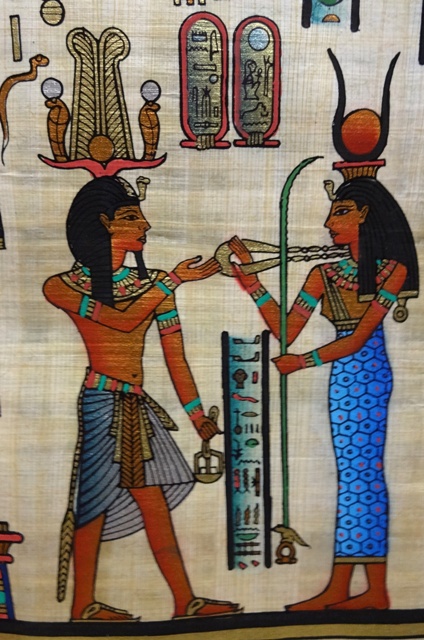
???????????????????????????????H would also be for the goddess Hathor, of whom I’m very fond. She appears in “Magic of the Nile” at a critical point and I have an unfinished novella  where she’s very key to events.  She was the Goddess of many things, but particularly of love, beauty, motherhood, music, joy and dancing, and could appear as a cow, a cow-headed woman, or a woman with curving cow horns.

Or, H can be for honeybee. Those little guys are so important to our food supply….plant flowers for them if you can, ok? This site seems to have a good year round list of what flowering plants the bees prefer.  We need the bees! (Yes, the bees are a total non sequitor from the subject of Egypt…)

So I’ll leave you with this photo from “The Mummy” – can’t talk about all that Ardeth Bey goodness and not have his picture anywhere. In our house we also quite loved Jonathan as portrayed by John Hannah.

Mummy snapshot

Ancient Egyptian Love Poems

Here’s one from the Archives, that I originally wrote for a guest post on Romancing the Book in 2012. The occasion was the Release of my first story set in Ancient Egypt, PRIESTESS OF THE NILE. I’m going to be publishing the sequel, MAGIC OF THE NILE, in March:

???????????????????????????????The heart of Priestess of the Nile is the love story between Sobek the Crocodile God and Merys, the priestess of one of his temples. Set in Ancient Egypt around 1500BC, the romance plays out against a paranormal background, as Sobek is a shifter who can be fully human (and very hot if I may say so!), half human/half crocodile or fully crocodile (along the scale of a dinosaur or dragon). The Ancient Egyptians were a romantic people and wrote many poems about love and romance.  With Valentine’s Day rapidly approaching, I thought that made a good topic….

“Poetry is perhaps the greatest forgotten treasure of ancient Egypt,” said Richard Parkinson, an expert on ancient Egyptian poetry at London’s British Museum, home to the largest collection of Egyptian artifacts outside of Cairo. (Interview for National Geographic News 4/20/2004).

Love poems have been found in many excavations of Egyptian ruins, from the tombs of the rich to the ruins of humble workers’ villages. It is believed that originally the poems were passed down through memorization, much as the minstrels of the Middle Ages would preserve their tales of chivalry and the love between knights and fair ladies. Eventually the poems were committed to papyrus or even scribbled in hieratic on shards of pottery and therefore preserved for us to enjoy. Students may have copied out parts of poems when practicing to become scribes.

Sobek didn’t happen to recite any poetry to Merys in the course of the novel (although I’m sure he probably made up for that lapse later LOL) but here’s one fragment of a poem dating to the time where my story occurs:

The Flower Song (Excerpt)
To hear your voice is pomegranate wine to me:
I draw life from hearing it.
Could I see you with every glance,
It would be better for me
Than to eat or to drink.

(Translated by M.V. Fox)

Here’s another fragment which I enjoy, taken from a much longer poem:

She looks like the rising morning star

At the start of a happy year.

Shining bright, fair of skin,

Lovely the look of her eyes,

Sweet the speech of her lips,

She has not a word too much.

VS_PriestessOfTheNile There was no specific celebration or day devoted to love and lovers that we know about, but the goddess Hathor was the Egyptian deity personifying love, beauty, music, motherhood and joy. We can imagine her festivals probably served as an excuse for many a pair of young lovers to enjoy each other’s company. I didn’t include Hathor in Priestess of the Nile but she’s definitely involved in a key scene in  MAGIC OF THE NILE.

Sobek and Merys managed to fall in love and find joy together without needing intervention from Hathor! My best wishes to you for a Happy Valentine’s Day.