Veronica sez: Decided to pull this post from the archives and run it again today because GoldieBlox is in the top four companies competing to win a Super Bowl advertising spot from the Intuit company! They need votes, go here to VOTE!
“Toys to inspire the next generation of female engineers…”
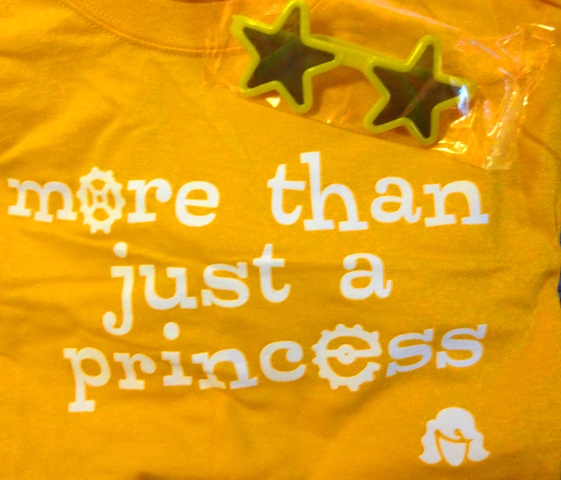
Last year I decided to take part in a Kickstarter project as a Backer, to see how the process worked – I thought it would be fun to have a project to root for. I kept my eye open for a suitable effort and very shortly was charmed by GoldieBlox in October. Their motto (as stated in a Kickstarter post) was “Gold is the new pink” and their goal was to tell the world “…our daughters are more than just princesses! GoldieBlox deserves to sit on the shelves next to Bob the Builder and Thomas the Train! To tell our girls: you can be ANYTHING you want to be when you grow up!”
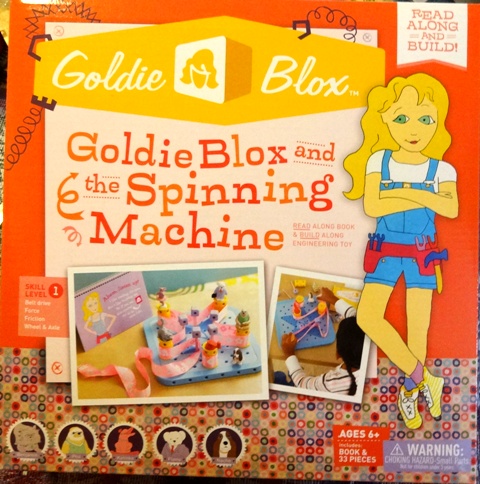
Debbie Sterling, a Stanford graduate and engineer-turned-entrepreneur created GoldieBlox out of frustration with how few girls pursue math, science and engineering, and how few toys are offered to support those interests. Even LEGOs expects girls to do the pink LEGO thing. (See the post I wrote on this topic last year, re LEGOs.) Sterling’s imaginative concept for GoldieBlox was to have a construction toy set and storybook starring the tool-wielding character. Research has shown that toys can play a critical role in early development of interest in the scientific and technical aspects and Ms. Sterling was frustrated that girls toys pretty much focused on fashion and beauty.
Sterling wrote and illustrated the GoldieBlox book, in which Goldie invents machines and problem solves. She does have animal sidekicks (and there is some pink involved). The pegboard and tool kit allow kids to build whatever Goldie is building in the book, and 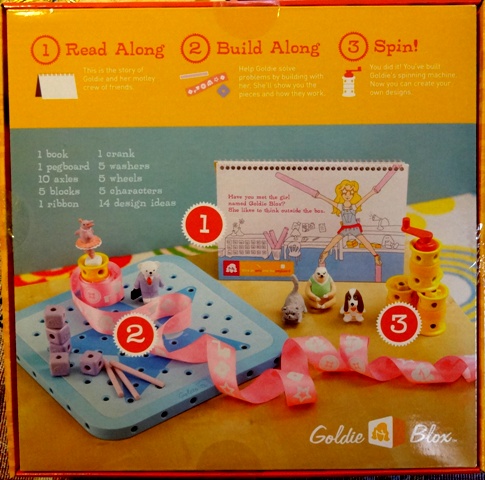 learn engineering concepts as they go, like how a wheel and axle work.
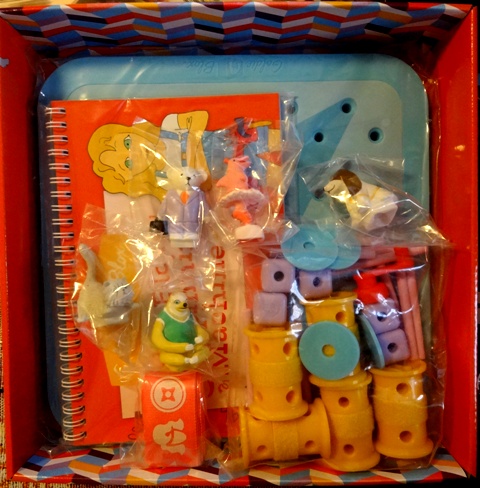
The kit I received contains Benjamin the cat, Nacho the dog, Katinka the dolphin in a pink tutu, Favio the white bear in a suit, and Phil the sloth in yellow. I would just say mildly, why is the male bear figure in a suit and the dolphin in a stereotypical pink tutu? However, the book gets good marks from me with templates for drawing your own designs and the use of technical terms from the get-go (bill of materials, axle). All the materials needed to duplicate Goldie’s engineering feat are included – a crank, washers, wheels, axles etc.
Nacho is a rescue dog who speaks Spanish. Katinka is a Russian ballerina (ok, so the pink makes sense). Phil the sloth breaks stereotypes by being the one who energetically encourages our Goldie to keep trying when she at first can’t figure out a more advanced problem. I don’t have any little girls handy to try the kit out on, unfortunately. The target group is age 6-9. Remembering my daughters at that age, I think they might have played with the kit, although they loved LEGOs (and not the pink ones either).
GoldieBlox had over 50 five star reviews on at least one distributor site I looked at (they’re still on pre-order status at Amazon.)
Now that the first kits have shipped, Ms. Sterling plans to create more kits, with increasing complexity, I assume, and I read she hopes to have an iPAD interactive version available within a year. Interestingly, a professor at Pennsylvania State is going to track the success or failure of this effort to challenge the toy industry stereotypes. I think the list price, at $29.99, seems a bit steep and may present some challenges in achieving wide adoption, however, I’m assuming as the GoldieBlox line of items grows, there may be bigger and smaller kits, accessories etc.
It would be nice to have an actual Goldie action figure in the kit…
As far as the Kickstarter process itself, the initial goal was $150K at first, later $400K as the fundraising became quite successful. As a Backer, I was very satisfied – we got regular updates on progress via e mail and videos posted to youtube. The project had the problems you might expect in dealing with foreign manufacturers, a few design issues (holes too big in the first pegboards), etc. But the day I received my Backer Box with the toy, my T shirt and Goldie glasses, I was so pleased to have played a very teeny part in this innovative, worthwhile and fun idea. Now I’m looking for another small Kickstarter effort to back!
You can find out more at http://www.goldieblox.com/