Ancient Egyptian Beer Had Bubbles and Saved the World

???????????????????????????????

Recently there were stories of a newly discovered ancient Egyptian tomb – no, not a new pharaoh or queen, but the tomb of “A Maker of Beer for the Gods of the Dead”, one Khonso Em Heb. (Here’s the CNN story with photos.) This gentleman lived about 500 years after the era where I’ve set my “Tales of the Gods” paranormal romances, but one thing he, my characters and pretty much all ancient Egyptians shared was a love for beer.

Beer was cheaper than wine, even in ancient times and was thick, sweet and nutritious. One leading Egyptologist, P. M. Chou, is quoted in the CNN  article as saying:

“While it’s a close cousin to modern beer, it’s manufacture was more primitive and they had to use a tube to extract the liquid from below which would have had a fermented layer of substance floating on the top of the jar,” he said.

“It would have had bubbles,” he added.

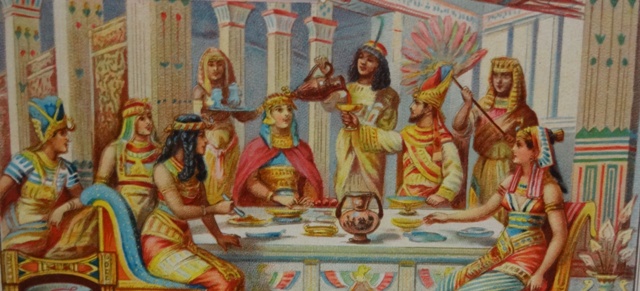
Not only was beer a staple drink, Egyptians consumed the beverage often, even at breakfast, and included beer as offerings to the gods and goddesses. Workers could even be paid in beer. Women typically took the lead as brewers, and although there were various techniques, the drink was often made with a yeast bread, baked then crumbled into pieces and strained into water flavored with dates and other spices or fruits. An alternative method of beer making involved heating barley and emmer, mixing them with yeast and malt and allowing the liquid to ferment. Quite a few tomb paintings have been found, depicting the beer making process.

Two favorite quotes of the Ancient Egyptians were:

“The mouth of a perfectly contented man is filled with beer” from around 2200 BCE and an instruction to young scribes that read (your mother) “…sent you to school when you were ready to be taught writing and she waited for you daily at home with bread and beer…” Their version of an afterschool snack! The last fragment is from my time period, the Eighteenth Dynasty, around 1550 BCE…

As far as beer saving the world, there was a famous Egyptian myth that the goddess Sekhmet was sent  by Ra the Sun God to slay some humans who’d been conspiring against him but she got carried away with wrath and threatened to kill all humankind. Horrified she was going too far, Ra dyed beer red to simulate blood and poured it out for her in floods, getting her drunk enough to pass out. When she awakened, her killing rage had subsided and she left the remaining world in peace.

In my next novel, “Magic of the Nile,” which should be released this February, Sekhmet decides to repay a debt by helping my hero Sahure. Here’s an unedited excerpt from the novel (so, subject to change):

The Great One Sekhmet stood in the center of his office. Sahure blinked, astonishment flooding over him, but the goddess herself was in his office, staring at him from glowing amber cat eyes.  Clad in formfitting red robes hugging the curves of her voluptuous human body, curious rosettes of gold at the shoulders, she was barefoot and he saw her shapely arms ended in the deadly paws of the lioness. On her leonine head, atop an elaborately dressed wig, she was crowned with a golden sun disk, the symbolic uraeus wrapped around the glimmering diadem. Sparks of red and gold light flew from her crown as she regarded him, leaning on a staff crowned with papyrus buds. Slowly he went to his knees, arms crossed in respect.

“I’m honored, Great One.”

“I would taste the beer you offered, had I more time to spend with mortal concerns,” she said, tilting her head, feline whiskers twitching. Her sinuous tail curled around her ankles. “To business, mortal. My sisters are going to take part in a battle on your behalf tonight, the combat of which I spoke,” she said. “I’m here to intervene for you.”

Caught in her hypnotic gaze, Sahure felt as if he’d drunk deep from a highly intoxicating vintage, although he’d only had one cup of ordinary, military-issue beer at dinner. The room was spinning around him. He drew a deep breath to steady himself. “I don’t understand, my lady. Intervene in what? I mean no disrespect, but I’m sworn to Horus the Falcon and he’s given me no orders, requested no action on my part tonight.” Focus, fool, you’re dealing with one of the most dangerous of the Great Ones.

“I don’t speak of combat with sword and shield,” she said, revealing a glimpse of her impressive fangs, her voice almost a purr. “All things will become known to you in the proper time. Explanation tonight beyond what I’ve already revealed would be useless.”

Sahure kept a frown off his face with supreme effort. I’d like to be the judge of that.

But the goddess was still talking. “I acknowledge you’re not one of my children but you saved my beloved village of Kharga from the nomads and the Hyksos.” Her tail lashed angrily at the mention of the enemy, thumping the hard-packed dirt floor. Sighing, she stood taller. “You rescued those who are my children, the people here. You honored my priestess, gave freely to my celebrations, showed proper deference.”

Realizing she seemed to expect him to say something, Sahure nodded. “It was my honor to be of service, Great One.”

“In return I’ll guard you while you’re here in this place.” She pointed her paw at him, one claw extended. “When you are once again in Thebes, it will be the task of others to watch over you. Your task to protect Pharaoh.”

Why do the Great Ones love to speak in riddles? Thoroughly frustrated, Sahure took the risk of standing up. “I’m sorry, Great One, but I don’t understand–”

She extended her golden-furred paw to him, palm up. A curious amulet lay in the middle, in the shape of a tiny hand no bigger than his thumbnail, made of some crystalline stone, deep blue in color, with a cat’s eye depicted in the center, delineated in yellow, purple and black beads.  The amulet was woven into a black leather wristband. “This is for you,” Sekhmet said. “Give me your wrist.”

He extended his arm and the goddess tied the cord around his wrist, skillfully using her claws in place of fingers. Sahure felt a wave of cold run up his arm from where the curious blue hand touched his pulse. The chill ran through his heart and for a moment he couldn’t breathe. He felt Sekhmet’s tail curling around his ankles.

“I deal in magic of all kinds, mortal.” Sekhmet moved closer, putting one paw on his chest. “Therefore I know how to guard against the most evil sorcery, when I choose to intervene.”

“I-I don’t traffic with magic,” he said, searching his mind for any time he’d even remotely been involved with sorcery and spells and coming up empty. The heady smell of her blue lotus perfume was making his vertigo worse, interfering with his concentration on her words. “I’m a simple soldier, loyal to my Pharaoh.”

She nodded, patting his cheek with her massive paw, claws sheathed, before stepping away. “I know this. So I’ve given you a shield.”

He touched the amulet with his fingertips. “Why do I need to be shielded?”

And we’ll just stop there….for now!
???????????????????????????????

Is It Too Late? DANCER OF THE NILE Weekend Writing Warriors

better wewriwaContinuing on with my paranormal romance set in Ancient Egypt. Nima the dancer and Kamin, one of Pharaoh’s warriors, are traveling with the caravan for a few days as they seek to escape the pursuing enemy and get vital information to Pharaoh to stop an invasion. Nima is being exposed to various temptations involving her future as a dancer and Kamin realizes how much she means to him. But he’s got secrets he can’t share…

Today’s excerpt comes after the Minoan dance master Andrios provoked an argument between Kamin and Nima, after which she danced with the troupe, spending the night in their company, while Kamin kept a self-imposed watch over the area to be sure she was safe. There’s been some editing and odd punctuation to meet the eight sentence rule.

Far too early the next morning, Nima leaned on the stone wall surrounding the well, stifling a yawn and nibbled at a piece of journey bread, waiting for the caravan to push itself into motion. She’d deliberately spent the night away from Kamin again, testing her feelings for him, assessing the reality of what she was about to do. 

                Andrios and his dancers probably thought she was really considering Ptahnetamun’s offer and were excited, providing advice and encouragement. And I know Andrios is hoping my curiosity extends to his talents in lovemaking as well. But she knew she was just playing with the concept, living the nomad artist’s life by proxy for a night or two.

                The opportunity was opening up too late – even a few weeks ago, she’d have signed the contract and been gone without a backward glance. Why didn’t I ever at least talk to a caravan master about the possibilities? 

                Bracelets jangling, Thala nudged her in the ribs, “Here comes your man, looking for you.”

???????????????????????????????

I  love and appreciate your comments and feedback every week! Go here  to find all the other Weekend Writing Warriors and read  an amazing variety of  terrific excerpts…


The story:


Egypt, 1500 BCE


DancerOfTheNile_1600x2400Nima’s beauty and skill as a dancer leads an infatuated enemy to kidnap her after destroying an Egyptian border town. However, she’s not the only hostage in the enemy camp: Kamin, an Egyptian soldier on a secret mission for Pharaoh, has been taken as well. Working together to escape, the two of them embark on a desperate quest across the desert to carry word of the enemy’s invasion plans to Pharaoh’s people.


As they flee for their lives, these two strangers thrown together by misfortune have to trust in each other to survive.  Nima suspects Kamin is more than the simple soldier he seems, but she finds it hard to resist the effect he has on her heart.  Kamin has a duty to his Pharaoh to see his mission completed, but this clever and courageous dancer is claiming more of his loyalty and love by the moment. Kamin starts to worry, if it comes to a choice between saving Egypt or saving Nima’s life…what will he do?


Aided by the Egyptian god Horus and the Snake Goddess Renenutet, beset by the enemy’s black magic, can Nima and Kamin evade the enemy and reach the safety of the Nile in time to foil the planned attack?


Can there ever be a happy future together for the humble dancer and the brave Egyptian soldier who is so much more than he seems?


DANCER OF THE NILE, an Amazon Best Seller, is AVAILABLE on Amazon   Barnes & Noble   All Romance eBooks iTunes   Smashwords


A Real Princess of the Nile from 3000 Years Ago

meritamunramsesSometimes you can close your eyes and almost touch the past…

Meritamen is an actual woman who lived a few hundred years after the general time frame where I place my “Tales of the Gods” paranormal novels. That’s her in the photo, as depicted by royal sculptors. She was the daughter of Ramses the Great and his favorite wife, Nefertari, and had at least four brothers and a younger sister. She played the sistrum, she danced, she sang…she was evidently a great favorite with Ramses II, being depicted in many of the official statues and paintings with him. Some of the titles and inscriptions regarding Meritamen talk of her being “fair of face,” with a beautiful forehead, as well as references to her perfume and that she was apparently very well spoken.

There’s a scene in her tomb where she’s depicted as bringing boxes of clothing with her to the Afterlife. I love that touch!

Meritamen1drawingShe was buried in the Valley of the Queens but the whereabouts of her mummy are unknown. Only the lid of her sarcophagus is in Berlin today.

So why are we talking about this relatively minor figure, shown to the left in a reproduction of a painting from her tomb? Out of all the players in ancient Egypt’s thousands of years of history, what makes her my blog subject today?

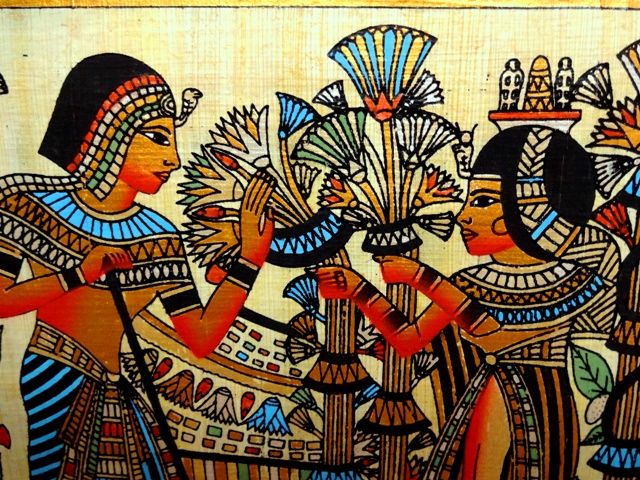
While writing my novels, I’ve built up a collection of what I call “faux Egyptiana” – museum reproductions of famous statues, trading cards and woodcuts from the late 1800’s depicting tomb paintings and scenes, modern papyrus paintings that approximate the gorgeous art of the ancients, fashion jewelry – but my budget doesn’t run to any “real” antiquities. I do from time to time, however, indulge in minor purchases of amulet beads purporting to be from the Egyptian New Kingdom, which is the era I’ve placed my novels in.

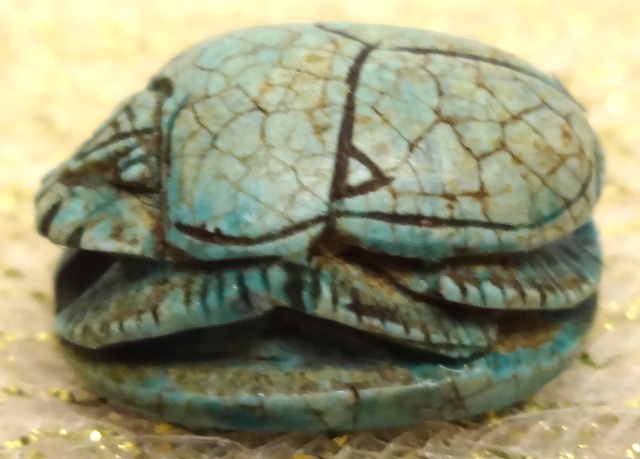
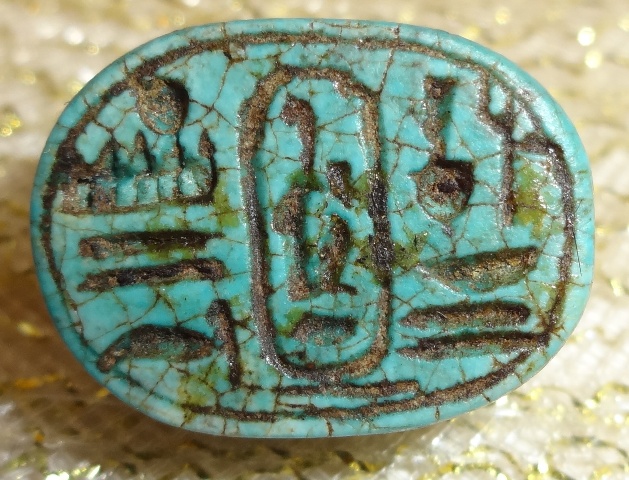
???????????????????????????????A few weeks ago I gave in to the intense desire to own this tiny scarab made of blue steatite (a form of soapstone) with what is believed to be Meritamen’s cartouche on the flat side. The bead came with a scholarly discourse stating the amulet can quite reasonably be assumed to have been hers, based on technical considerations too numerous to mention here. I loved the idea of having something that actually dates back to the time frame I write about.

OK, I can hear the sceptics now. Even with a great provenance and scholarly details, there’s no proof this bead is really hers or is thousands of years old. I do know that. Even in the days of ancient Greece and Rome, clever artisans made fake “antiquities” for the tourists to buy. So it’s probably a skillful fake. But…

But I choose to believe this might be real. When the package came and I gingerly took the tiny bead out (it’s about the size of my ???????????????????????????????thumbnail) I felt this indescribable flash of something…this bead isn’t like anything else I’ve ever unwrapped. I can’t really describe it any better than that. I felt I was holding a fragment of antiquity in my hand.

Fake, real? Does it ultimately matter? For a few moments a connection has been forged between me and this genuine person from the time I write about, and now there’s a link between you and Meritamen as well.

Photos courtesy of Wikimedia:  This file is licensed under the Creative Commons Attribution-Share Alike 3.0 Unported License  and represents no endorsement of the post or of Veronica Scott by Kurohito (photo #1) or Anneke Bart (photo #2) respectively. Photos of scarab bead are author’s own.

???????????????????????????????